
Written by Angela Iobst
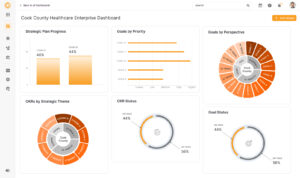
AI-powered strategic portfolio management helps organizations connect strategy to execution. Most organizations don’t lack strategy—they lack the ability to align goals, initiatives, and KPIs across execution.
Plans get built in boardrooms. Then they sit in slide decks while day-to-day decisions happen in silos, disconnected from the goals that were set. KPIs drift. Initiatives stall. And by the time leadership notices, the quarter is already lost.
That’s the problem strategic portfolio management was built to solve. And now, with AI in the mix, it’s doing a lot more than tracking progress on a dashboard.
This guide breaks down what AI-powered strategic portfolio management actually is, how it works, why it matters right now, and what to look for in a platform if you’re ready to make the shift.
What Is AI-powered SPM (Strategic Portfolio Management)?
Strategic portfolio management is how organizations connect their goals to their work.
It’s the practice of aligning your initiatives, resources, KPIs, and teams around a defined strategy — and then tracking whether execution is actually delivering the results you planned for.
At its core, SPM answers three questions:
- Are we working on the right things?
- Are our resources going where they’ll have the most impact?
- Are we actually making progress toward our strategic goals?
Without a system for this, most organizations end up in reactive mode — constantly firefighting, overspending on low-priority projects, and struggling to explain results to the board.
Core-Strategy’s strategy execution framework is built specifically around this challenge — helping teams move from strategic intent to measurable outcomes without losing visibility along the way.
What Makes It “AI-Powered”?
Traditional SPM tools help you track what’s happening. AI-powered SPM helps you understand what it means — and what to do next.
Here’s the difference in practice:
Traditional SPM
- Shows you current status of initiatives and KPIs
- Requires manual data input and reporting
- Surfaces problems after they’ve already happened
- Relies on scheduled reviews to catch misalignment
AI-Powered SPM
- Detects execution gaps and risks before they escalate
- Generates executive reports and performance narratives automatically
- Recommends resource adjustments based on portfolio data
- Flags when initiatives are drifting from strategic goals in real time
The shift is from passive reporting to active intelligence. Instead of waiting for a quarterly review to discover that three initiatives are off track, AI surfaces that insight the moment the data signals a problem.
This is exactly what Core-Strategy’s AI-enabled strategy planning is designed to do — keep leadership informed without adding more manual work to your team’s plate.
This is what makes AI-powered SPM different from traditional portfolio tracking tools.
Why AI-powered SPM Matters in 2026
The way executives make decisions has changed. Speed matters more than ever, and the tolerance for slow, manual reporting cycles has dropped significantly.
A few things are driving this:
Complexity has gone up
Organizations are running more initiatives across more teams than ever before. Without a system that can process that complexity, important signals get lost.
Boards expect real-time visibility
Leadership teams are no longer willing to wait for a monthly deck to understand performance. According to executive dashboard best practices, organizations are increasingly prioritizing real-time visibility and faster decision-making across leadership teams.
AI has made it practical
Five years ago, the technology to do this at scale didn’t exist for most organizations. Now it does. Platforms can process portfolio data, flag anomalies, and generate insights without a team of analysts behind them.
The combination of AI dashboards and reporting with strategic alignment tools means leadership can finally have the visibility they’ve always needed — without the overhead.
Core Components of AI-Powered SPM
Not all platforms are built the same. Here’s what a real AI-powered SPM solution should include:
1. Goal and OKR alignment
Your strategy needs to cascade. That means organizational goals translate into team-level OKRs, which connect to individual projects and KPIs. If any layer breaks, you lose visibility into whether the strategy is working.
Core-Strategy’s OKR and KPI management module connects these layers so nothing falls through the cracks.
2. Portfolio visibility
You need a single view of all active initiatives — their status, dependencies, resource load, and alignment to strategic goals. Without this, prioritization becomes guesswork.
See how portfolio management works inside Core-Strategy.
3. AI-driven insights and alerts
This is where the intelligence comes in. The platform should proactively surface risks, flag underperforming initiatives, and identify where resources are misaligned — not just show you a status dashboard.
4. Automated executive reporting
Manual reporting is one of the biggest time sinks in any strategy function. AI should be able to generate leadership-ready summaries, portfolio updates, and performance narratives based on live data — not a spreadsheet someone built on Friday afternoon.
5. Integrated strategic framework
Everything needs to connect. Environment scanning, strategy formulation, execution, and evaluation should all live in one system so your team isn’t managing five different tools to get a complete picture.
Core-Strategy’s integrated strategic framework was built around this end-to-end view.
Who Needs AI-Powered SPM?
The short answer: any organization that has a strategy and needs to execute it.
In practice, AI-powered SPM is especially valuable for:
- Government agencies managing cross-departmental programs and public accountability requirements
- Healthcare organizations aligning clinical operations with strategic performance goals
- Defense and aerospace contractors managing complex portfolios with strict delivery timelines
- Large enterprises running multiple business units that need portfolio-wide visibility
- Organizations going through transformation initiatives where strategic alignment is critical
If your leadership team is regularly asking “how are we doing against our strategy?” and the answer involves pulling together data from multiple sources — you need an SPM platform.
Organizations adopting AI-powered SPM gain real-time alignment between strategy and execution.
Common Problems SPM Solves
Here are the situations we hear most often from organizations before they implement an SPM platform:
“Our strategy lives in a deck, not in our daily work”
Strategic plans get built and then filed away. Teams keep working on what’s in front of them, not what’s aligned to the organizational goals. SPM closes that gap by connecting strategy directly to initiatives and KPIs.
“We don’t know which projects to prioritize”
When everything feels urgent, nothing gets prioritized. SPM gives leadership a portfolio view that makes trade-off decisions easier and more defensible.
“Our reporting takes too long”
Pulling together a monthly strategy update shouldn’t take a week. AI-generated reporting means your team spends less time building decks and more time acting on insights.
“We find out about problems too late”
Most strategy reviews are backward-looking. By the time you identify that an initiative is off track, the window to course-correct has already closed. AI-powered SPM flags issues early, while there’s still time to act.
What to Look for in an AI-Powered SPM Platform
If you’re evaluating options, here are the questions worth asking:
- Does it connect strategy to execution end-to-end, or is it just a project tracker?
- Can it generate reports automatically, or does someone still have to build them manually?
- Does the AI surface insights proactively, or do you have to go looking for them?
- Can it scale across your entire organization, or just one team?
- Does it integrate with the tools your teams already use?
The best platforms don’t just show you data. They help you act on it.
Frequently Asked Questions
What is the difference between SPM and project management?
Project management focuses on delivering individual projects on time and on budget. Strategic portfolio management is about ensuring the right projects are being run in the first place — and that collectively, they’re moving the organization toward its strategic goals.
Is AI-powered SPM only for large enterprises?
No. While enterprise organizations benefit significantly from SPM, any organization with a defined strategy and multiple active initiatives can use it. The key is having enough complexity that manual tracking breaks down.
How long does it take to implement an SPM platform?
It depends on the platform and the size of your organization. Core-Strategy is designed to get teams up and running quickly, with a structured onboarding process that starts with system initiation and environment scanning before moving into full strategy execution.
Can SPM platforms integrate with tools we already use?
Yes. Core-Strategy supports enterprise integrations with the tools your teams are already working in, so you don’t have to rip and replace your existing stack.
Ready to See It in Action?
If your organization is serious about connecting strategy to execution — and using AI to do it at scale — Core-Strategy was built for exactly that.
Book a demo at core-strategy.us and see how AI-powered strategy execution works in practice.
