
Written by Angela Iobst
Every organization has a strategy. Not every organization executes one.
That gap — between what leadership intends and what actually happens — is one of the most expensive problems in business. Studies consistently show that the majority of strategic plans fail not because the strategy was wrong, but because the execution broke down.
Planning is the part organizations tend to get right. It’s structured, visible, and it has a clear output: a document, a deck, a set of goals. Execution is messier. It happens across teams, over months, through hundreds of small decisions that either move the organization forward or quietly pull it off course.
This post explains the real difference between strategy planning and strategy execution, why organizations struggle with both, and what it takes to connect them in a way that actually holds.
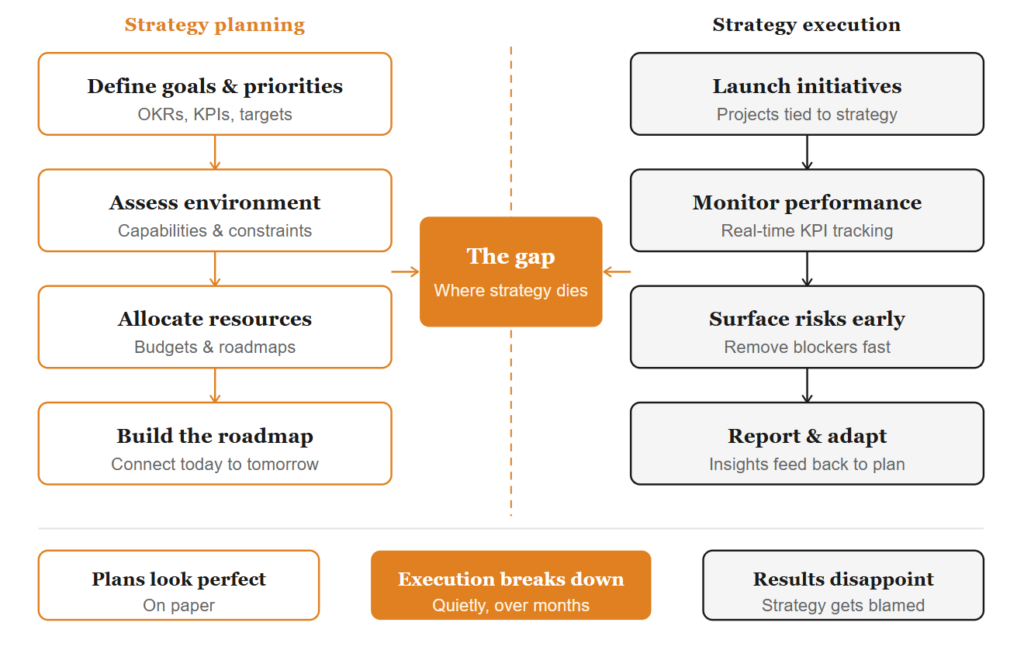
Strategy Planning vs. Strategy Execution: What’s the Actual Difference?
They sound like two phases of the same process. They’re actually two different disciplines.
Strategy planning
Planning is the work of deciding where you’re going. It includes:
- Defining organizational goals and priorities
- Assessing the external environment and internal capabilities
- Setting OKRs, KPIs, and performance targets
- Allocating resources and budgets to strategic initiatives
- Building the roadmap that connects today’s operations to tomorrow’s goals
Done well, strategy planning gives every team a clear picture of what the organization is trying to achieve and how their work contributes to it.
Core-Strategy’s strategy formulation module is designed to make this process structured and repeatable — not a once-a-year exercise that gets forgotten by February.
Strategy execution
Execution is the work of getting there. It includes:
- Turning strategic goals into active initiatives and projects
- Keeping teams aligned as priorities shift and conditions change
- Monitoring performance against KPIs in real time
- Identifying risks and removing blockers before they stall progress
- Reporting progress to leadership in a way that supports decision-making
Execution is where most strategies die. Not dramatically — quietly. One missed milestone, one misaligned team, one initiative that was never properly connected to the goals it was supposed to support.
See how Core-Strategy approaches strategy execution as a continuous, connected process rather than a project management add-on.
Why Organizations Struggle with Strategy Planning
Planning gets a lot of attention, so it’s tempting to assume organizations are good at it. But planning has its own failure modes.
Planning in isolation
When strategy is built by a small leadership team and then handed down, it often doesn’t reflect operational reality. Teams feel disconnected from goals they had no part in setting. Initiatives get prioritized without input from the people who have to deliver them.
Planning without alignment to capabilities
Ambitious goals need to be grounded in what the organization can actually do. A strategy that ignores capacity, capability gaps, or resource constraints isn’t a strategy — it’s a wish list.
This is why Core-Strategy builds environment scanning and capability mapping into the planning process from the start.
Planning that doesn’t connect to execution
The most common failure mode: a strategy that lives in a document and never makes it into the work. If your strategic plan isn’t directly connected to the initiatives your teams are running and the KPIs they’re tracking, it’s not driving anything.
Planning on a fixed annual cycle
The world moves faster than a 12-month planning cycle. Organizations that only revisit their strategy once a year end up executing plans that no longer match their environment. Planning needs to be continuous — or at least adaptive.
Why Organizations Struggle with Strategy Execution
Execution is harder, and the failure points are more numerous.
No clear line of sight from goals to work
If your team can’t draw a direct line from what they’re working on to a strategic goal, execution breaks down. People default to what feels urgent rather than what’s strategically important.
Core-Strategy’s OKR and KPI management creates that line of sight — connecting organizational goals to team-level objectives to individual initiatives in a single system.
Siloed execution across teams
Strategy execution rarely lives in one team. It spans departments, business units, and sometimes geographies. When those teams are running their own systems and reporting in different formats, the organization loses the ability to see the whole picture.
Reactive rather than proactive management
Most execution problems are visible in the data before they become visible in outcomes. But if your team is only reviewing performance monthly, you’re always behind. By the time you identify that an initiative is off track, the window to course-correct has often already closed.
Reporting that takes longer than it should
Strategy reviews require data from multiple sources, assembled by hand, turned into a presentation, and then reviewed by people who needed it last week. This cycle slows everything down and reduces the credibility of the insights.
Resources misaligned with priorities
Even when goals are clear, resources often don’t follow them. High-priority initiatives get underfunded while legacy projects hold on to budget and headcount. Without portfolio-level visibility, these misalignments are nearly impossible to catch.
Core-Strategy’s portfolio management gives leadership a real-time view of how resources are allocated across the portfolio — and where the gaps are.
The Gap Between Planning and Execution: Why It Exists
Most organizations treat planning and execution as separate activities managed by different people on different timelines. The planning team sets the goals. The execution teams figure out how to deliver them. The two groups meet once a quarter to compare notes.
That model doesn’t work anymore.
The organizations that execute strategy well treat planning and execution as a continuous loop, not a handoff. Strategy informs execution. Execution informs strategy. The two need to be connected in real time — which means they need to live in the same system.
Here’s what that loop looks like in practice:
- Strategy is defined with clear goals, OKRs, and KPIs.
- Initiatives are created and connected directly to those goals.
- Resources are allocated based on strategic priority, not inertia.
- Performance is monitored continuously, not just at review cycles.
- AI surfaces risks and misalignments before they become problems.
- Insights from execution feed back into planning to keep strategy current.
This is the model behind Core-Strategy’s integrated strategic framework — a connected system where planning and execution reinforce each other rather than operating in silos.
What Good Execution Actually Looks Like
It’s worth being specific, because “good execution” gets talked about a lot without much substance behind it.
Organizations that execute strategy well tend to share a few characteristics:
Everyone knows what the priorities are
Not just the leadership team. Every manager, every team lead, every person running an initiative understands what the organization is trying to accomplish and how their work connects to it.
Performance data is visible and current
KPI dashboards aren’t updated quarterly — they reflect what’s happening now. Leadership can see the state of the portfolio at any time without waiting for a report to be built.
Problems surface early
The organization doesn’t wait for a missed deadline to discover that an initiative was struggling. Signals are caught early — through AI-driven monitoring, not manual reviews — and addressed before they escalate.
Reporting is generated, not assembled
Executive updates and board reports aren’t built by analysts pulling data from spreadsheets. They’re generated automatically from live portfolio data, freeing up the team to focus on action rather than administration.
Core-Strategy’s AI-powered planning assistant handles this automatically — generating leadership-ready narratives from your live strategy and performance data.
Strategy adapts as conditions change
When the environment shifts — a new competitor, a regulatory change, a budget cut — the organization can quickly assess the impact on the portfolio and adjust priorities without losing momentum.
The Role of Technology in Closing the Gap
You can’t manage a modern strategy execution program on spreadsheets and slide decks. The complexity is too high, the data is too distributed, and the pace of change is too fast.
Technology doesn’t replace good strategic thinking. But it removes the friction that keeps good strategic thinking from translating into results.
A proper strategy execution platform should:
- Give leadership a single view of the entire portfolio — goals, initiatives, KPIs, resources — in real time
- Connect planning directly to execution so there’s no handoff gap
- Use AI to monitor performance continuously and flag issues before they escalate
- Generate executive reporting automatically so reviews are based on insights, not on whoever had time to build a deck
- Make resource allocation visible so priorities are backed by investment, not just intention
This is exactly the problem Core-Strategy was built to solve — not just as a reporting tool, but as an end-to-end execution intelligence platform.
Signs Your Organization Needs to Rethink Its Approach
If any of these sound familiar, the gap between planning and execution is costing you:
- Your strategic plan was built in Q4 and hasn’t been seriously revisited since
- Teams are working hard but leadership isn’t sure how their work connects to the strategy
- Your quarterly strategy review takes a week to prepare and still feels incomplete
- You find out about execution problems at review meetings, not before them
- Resources are allocated based on last year’s budget, not this year’s priorities
- Your OKRs and KPIs live in a spreadsheet that may or may not be current
- Different business units are measuring performance in completely different ways
None of these are signs of organizational failure. They’re signs of a system problem — and system problems have system solutions.
Frequently Asked Questions
What is the most common reason strategy execution fails?
The most common reason is the disconnect between where strategy is set and where work actually happens. When goals aren’t directly connected to initiatives, KPIs, and resource allocation, execution drifts. Teams work hard on things that don’t move the strategy forward, and the gap only becomes visible when results disappoint.
How is strategy execution different from project management?
Project management is about delivering a defined scope on time and on budget. Strategy execution is about ensuring the right projects are being run, they’re aligned to organizational goals, and collectively they’re moving the business in the right direction. Project management operates at the initiative level; strategy execution operates at the portfolio level.
What is an OKR and how does it connect planning to execution?
OKR stands for Objectives and Key Results. It’s a goal-setting framework that connects high-level organizational objectives to measurable outcomes at the team level. When implemented properly, OKRs create a direct line of sight between what the organization is trying to achieve and what every team is working on. The challenge is keeping them current and connected to actual work — which is where an integrated platform makes the difference.
How often should strategy be reviewed?
The traditional annual strategy review is no longer sufficient for most organizations. Best practice is a combination of continuous monitoring through KPI dashboards, quarterly strategy reviews to assess portfolio performance and realign priorities, and an annual planning cycle for longer-term goal setting. The key is having the data infrastructure to support continuous monitoring without it requiring manual effort.
Can small organizations benefit from strategy execution platforms?
Yes. The fundamentals of connecting goals to work, monitoring performance, and making resource decisions based on strategic priority apply regardless of organization size. Smaller organizations often benefit most because they have less margin for error — a misaligned initiative or a late-detected problem has an outsized impact.
Close the Gap Between Planning and Execution
If your organization is serious about turning strategy into results — not just plans — Core-Strategy gives you the platform to do it. One connected system for planning, execution, performance monitoring, and AI-driven insights.
Book a demo at core-strategy.us and see how it works in practice.
Also read: What Is AI-Powered Strategic Portfolio Management? The Complete Guide
