
Written by Angela Iobst
When organizations plan for growth, transformation, or risk management, choosing the right strategic analysis framework can make the difference between clarity and confusion. Two of the most widely used tools—PESTLE Analysis and SWOT Analysis—often raise an important question: Which framework should you use, and when?
While both frameworks support strategic decision-making, they serve different purposes and offer distinct perspectives. Understanding how PESTLE and SWOT compare—and how they can complement each other—helps leaders make better, more informed strategic choices.
What Is PESTLE Analysis?
PESTLE Analysis is a macro-environmental framework used to assess external factors that may impact an organization. It helps leaders understand the broader forces shaping their business environment before defining or adjusting strategy.
PESTLE examines six key dimensions:
-
Political – Government policies, regulations, trade laws, and political stability
-
Economic – Inflation, interest rates, economic growth, employment levels
-
Social – Demographics, cultural trends, consumer behavior, workforce changes
-
Technological – Innovation, automation, AI adoption, digital disruption
-
Legal – Compliance requirements, labor laws, data protection regulations
-
Environmental – Sustainability, climate impact, environmental regulations
PESTLE analysis is especially valuable during strategy formulation, market entry planning, mergers, or major transformations, where understanding external risk and opportunity is critical.
What Is SWOT Analysis?
SWOT Analysis focuses on both internal and external factors to evaluate an organization’s current strategic position. It is widely used because of its simplicity and versatility.
SWOT breaks down into four areas:
-
Strengths – Internal capabilities, competitive advantages, core competencies
-
Weaknesses – Internal limitations, skill gaps, process inefficiencies
-
Opportunities – External market trends or conditions that can be leveraged
-
Threats – External risks, competition, regulatory or market challenges
SWOT is often applied during strategy reviews, business planning, product launches, or performance assessments, helping organizations translate insights into actionable initiatives.
PESTLE vs SWOT: Key Differences
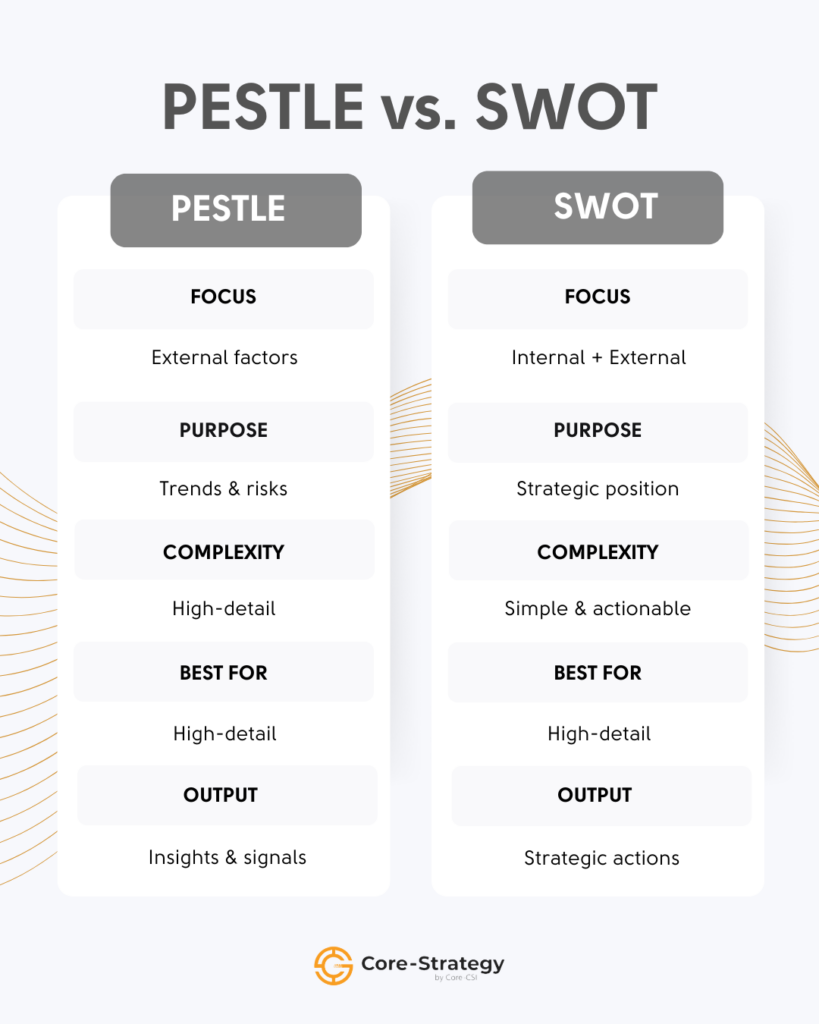
In short, PESTLE explains what’s happening around your organization, while SWOT explains how well your organization is positioned to respond.
When Should You Use PESTLE?
Use PESTLE Analysis when you need to:
-
Understand external forces affecting your industry
-
Anticipate regulatory, economic, or technological change
-
Assess market entry or geographic expansion risks
-
Support long-term strategic planning
PESTLE is particularly useful in volatile or highly regulated environments where external change can significantly impact strategy execution.
When Should You Use SWOT?
Use SWOT Analysis when you want to:
-
Assess organizational readiness and capabilities
-
Align initiatives with strengths and opportunities
-
Identify weaknesses that may limit execution
-
Prioritize strategic initiatives and investments
SWOT works well for execution-focused strategy management, helping teams move from insight to action.
Should You Use PESTLE or SWOT—or Both?
In practice, PESTLE and SWOT are most powerful when used together.
A common and effective approach is:
-
Start with PESTLE to understand the external environment
-
Feed key insights into SWOT, particularly Opportunities and Threats
-
Use SWOT outputs to define strategic goals, OKRs, and initiatives
This combined approach ensures strategies are both externally informed and internally achievable, reducing blind spots and improving decision quality.
Strategic Frameworks in Modern Strategy Management
In today’s fast-changing business landscape—driven by AI, digital transformation, and global uncertainty—strategic frameworks must be continuously updated and connected to execution.
Platforms like Core-Strategy SPM enable organizations to:
-
Embed PESTLE and SWOT insights into strategy planning
-
Link analysis directly to goals, OKRs, and projects
-
Continuously monitor risks, dependencies, and outcomes
-
Move from static analysis to dynamic, data-driven strategy execution
Conclusion
PESTLE vs SWOT is not an either-or decision. Each framework answers a different strategic question, and together they provide a comprehensive view of risk, opportunity, capability, and direction.
Organizations that combine external awareness (PESTLE) with internal alignment (SWOT) are better equipped to adapt, execute, and succeed in an increasingly complex strategic environment.
