
Written by Angela Iobst
AI is no longer “nice to have” in strategy conversations—it’s becoming part of the leadership operating system. The new expectation is simple: leaders need to make faster decisions with better information, while keeping teams aligned on outcomes. That’s where AI decision-making is shifting the game.
In this leadership POV, we’ll look at how AI strategy is evolving through forecasting, scenario modeling, and automated reporting—plus how organizations can turn predictive insights into clearer execution.
What “AI Decision-Making” Actually Means (and What It Doesn’t)
Let’s demystify it.
AI decision-making does not mean handing strategy over to an algorithm. It means using AI to:
-
Surface patterns humans miss
-
Forecast likely outcomes
-
Run scenario comparisons quickly
-
Summarize execution signals into decision-ready reporting
In other words, AI doesn’t replace leadership judgment—it upgrades it.
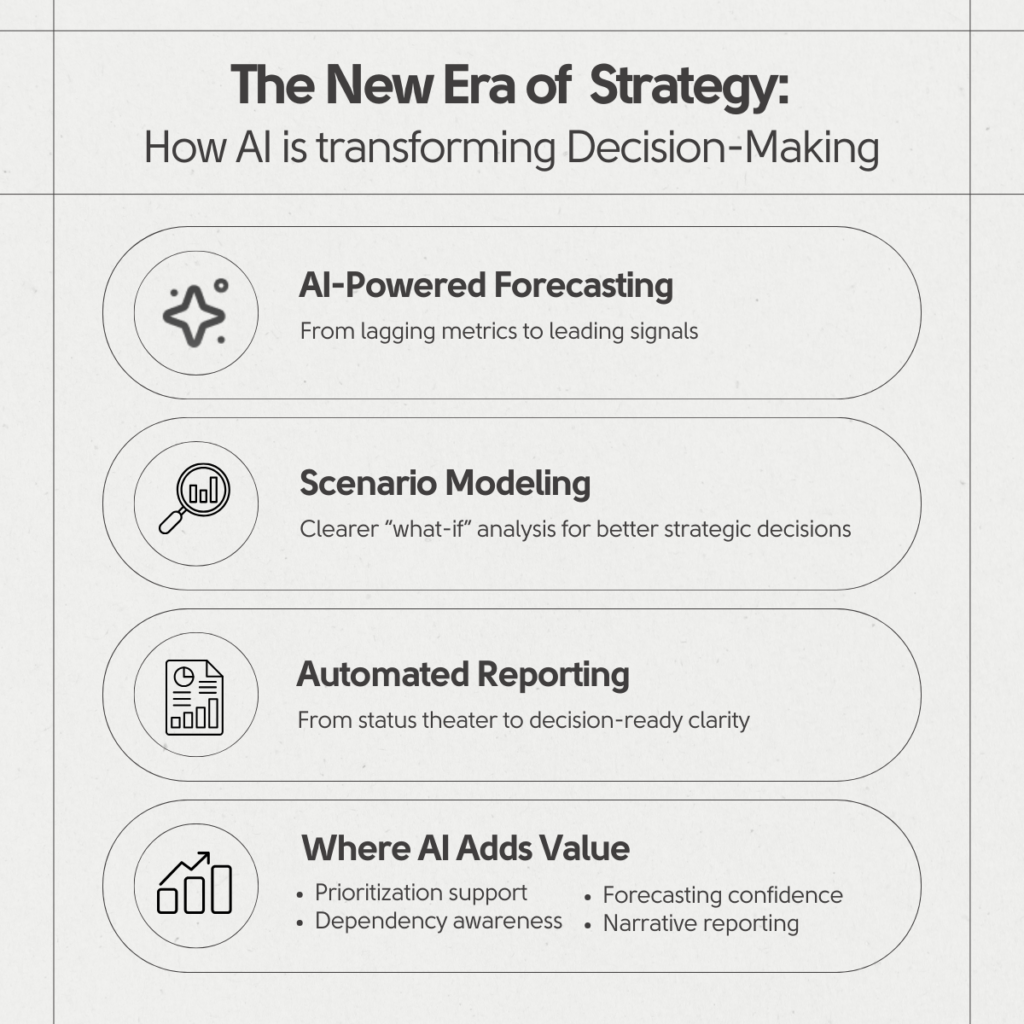
1) AI-Powered Forecasting: From Lagging Metrics to Leading Signals
Traditional strategy reviews often rely on lagging indicators: last month’s performance, last quarter’s delivery, last week’s status reports. By the time leaders see the signal, it’s already old.
With predictive insights, teams can spot risk earlier by analyzing signals such as:
-
shifting capacity constraints
-
delays across dependent initiatives
-
changing customer or market indicators
-
performance patterns across similar work
The practical result: leaders move from reacting to issues to preventing them.
Leadership takeaway: Forecasting shouldn’t be a quarterly surprise. It should be a weekly advantage.
2) Scenario Modeling: Better Decisions Start With Better “What If”
Most strategy failures aren’t caused by bad intent. They come from bad tradeoffs:
-
too many priorities
-
underfunded initiatives
-
hidden dependencies
-
unrealistic timelines
Scenario modeling helps leaders answer questions like:
-
What happens if we pause initiative A and fund initiative B?
-
What is the fastest path to outcome X given current capacity?
-
Which initiatives create the most downstream blockage?
-
What are the risks if we accelerate this roadmap?
This is where AI strategy becomes a force multiplier: the more complex your organization, the more valuable scenario modeling becomes.
Leadership takeaway: The best strategy isn’t the boldest plan—it’s the plan you can actually execute.
3) Automated Reporting: From Status Theater to Decision-Ready Clarity
Leaders don’t need more dashboards. They need fewer surprises.
A common pain point: reporting takes too long, requires too much manual work, and still doesn’t answer the questions leaders care about:
-
What changed since last review?
-
What is off-track—and why?
-
What decisions are needed now?
-
What should we stop doing?
AI can help by summarizing:
-
key changes in execution
-
risks and blockers
-
trend shifts across teams
-
progress toward outcomes (not just activity)
When reporting becomes automated and consistent, meetings become about decisions—not updates.
Leadership takeaway: Reporting should reduce friction, not create it.
Where AI Adds the Most Value in Strategy Execution
AI delivers the strongest value when it’s applied to real leadership bottlenecks:
High-impact AI use cases
-
Prioritization support (tradeoffs based on impact/cost/risk)
-
Dependency awareness (surfacing constraints earlier)
-
Forecasting delivery confidence (probability-based planning)
-
Narrative reporting (executive summaries in plain language)
The common thread: AI helps leaders see the portfolio as a system, not a set of disconnected initiatives.
The Risks Leaders Should Watch (and How to Manage Them)
AI is powerful—but not magic. Leaders should plan for:
1) Garbage in, garbage out
If data quality is poor, AI will confidently produce weak guidance. Start by improving inputs: definitions, ownership, and consistent reporting.
2) Over-trusting the model
AI should provide recommendations, not final calls. Keep a human-in-the-loop review process for major strategic decisions.
3) Misaligned incentives
If teams feel punished for transparency, the data becomes political. Build psychological safety and reward accuracy over perfection.
Leadership takeaway: AI works best in healthy operating systems—not chaotic ones.
A Practical Adoption Path for AI Strategy (Without the Hype)
If you’re starting now, a phased approach works best:
-
Standardize your execution data (initiatives, owners, outcomes, timelines)
-
Introduce AI summaries for reporting (reduce manual work first)
-
Add forecasting and scenario modeling (support leadership decisions)
-
Operationalize governance (cadence + decision rules + accountability)
This creates momentum without overwhelming teams.
Conclusion: AI Is Changing Strategy From “Planning” to “Sensing”
The new era of strategy is faster, more adaptive, and more measurable. With AI decision-making, leaders can move from static plans to dynamic execution—powered by forecasting, modeling, and predictive insights.
If you want to see how Core-Strategy supports modern execution, explore:
