
Written by Angela Iobst
Strategy work breaks down when priorities multiply, teams operate in silos, and funding follows last year’s assumptions. Strategy portfolio management (SPM) solves this by giving leaders a clear, continuously updated view of what initiatives matter most—and what to stop, start, or scale.
This guide explains what strategy portfolio management (SPM) is, how it differs from OKRs and PMOs, and why modern organizations increasingly rely on an SPM platform to execute strategy with speed and clarity.
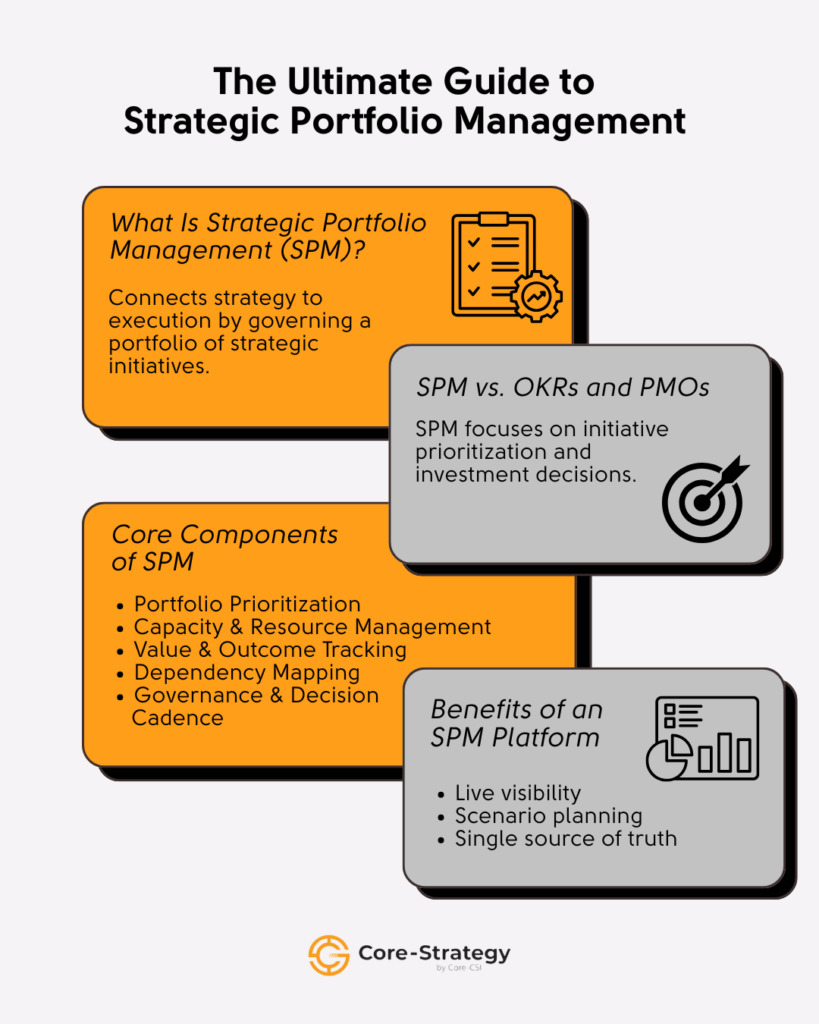
What Is Strategy Portfolio Management (SPM)?
Strategy portfolio management (SPM) is a management approach that connects strategy to execution by governing a portfolio of strategic initiatives. Instead of managing projects in isolation, SPM helps you:
-
Prioritize initiatives based on strategic value
-
Balance capacity, budget, and risk across the portfolio
-
Track outcomes and dependencies end-to-end
-
Make tradeoffs quickly as conditions change
In short, SPM answers: Are we investing in the right work—and are we getting the outcomes we planned?
Why Strategy Portfolio Management Matters Now
Modern organizations face faster cycles, more initiatives, and more stakeholders. Without a portfolio lens, execution becomes noisy:
-
Too many “critical” initiatives dilute focus
-
Teams compete for the same resources
-
Leaders lack visibility into dependencies and bottlenecks
-
Reporting is retrospective instead of decision-ready
With strategy portfolio management, leaders can make ongoing, data-informed decisions—especially when priorities shift mid-quarter.
Strategy Portfolio Management vs. OKRs: What’s the Difference?
OKRs are great for defining goals and aligning teams. However, OKRs don’t always solve portfolio-level decisions like funding, sequencing, and tradeoffs.
OKRs typically focus on:
-
Goals and measurable outcomes
-
Team alignment and accountability
-
Progress tracking against targets
SPM focuses on:
-
Initiative prioritization and investment decisions
-
Capacity and resource allocation across the org
-
Dependencies, governance, and execution visibility
A practical way to think about it:
-
OKRs define what success looks like
-
SPM governs the work that delivers that success
Used together, they’re powerful: OKRs clarify outcomes; strategy portfolio management ensures the portfolio can realistically deliver them.
Strategy Portfolio Management vs. PMO: What’s the Difference?
A traditional PMO often emphasizes project controls: timelines, status reporting, and delivery process consistency. That’s valuable—but it can miss the strategic layer.
PMO strengths:
-
Standardized delivery practices
-
Project tracking and reporting
-
Risk and issue management
SPM strengths:
-
Strategy-to-investment alignment
-
Portfolio tradeoffs (what to stop/start)
-
Outcome-based governance
-
Enterprise-wide dependency visibility
In many organizations, SPM modernizes the PMO by shifting the conversation from “Are projects on track?” to “Are we executing the right strategy?”
The Core Components of Strategy Portfolio Management
To implement strategy portfolio management effectively, most organizations build around these core components:
1) Portfolio Prioritization
A repeatable system to rank initiatives based on strategic impact, cost, and urgency.
2) Capacity & Resource Management
Visibility into who can do the work, when, and what tradeoffs are required.
3) Value & Outcome Tracking
Connecting initiatives to measurable outcomes—not just activity and milestones.
4) Dependency Mapping
Surfacing cross-team blockers early so leaders can sequence work intelligently.
5) Governance & Decision Cadence
A consistent operating rhythm (monthly/quarterly) for reviewing progress and rebalancing the portfolio.
What to Look for in an SPM Platform
As complexity rises, spreadsheets and slide decks can’t keep up. An SPM platform helps organizations operationalize strategy portfolio management with live visibility and decision support.
Look for an SPM platform that supports:
-
Strategic initiative intake and scoring
-
Portfolio views (by objective, theme, business unit)
-
Dependencies and cross-functional planning
-
Progress dashboards tied to outcomes
-
Executive-ready reporting
-
Scenario planning (“What if we pause X and fund Y?”)
If your organization is scaling, or frequently reprioritizing, an SPM platform becomes the system of record for strategic execution.
Who Needs Strategy Portfolio Management?
Strategy portfolio management is especially useful for:
-
Mid-to-large orgs with many cross-functional initiatives
-
Leadership teams struggling to prioritize
-
Companies undergoing transformation or rapid growth
-
Organizations managing strategy across multiple regions/business units
If you hear “everything is a priority,” you likely need SPM.
Common Mistakes When Rolling Out SPM (and How to Avoid Them)
-
Mistake: Treating SPM as a reporting layer.
Fix: Use SPM to drive decisions, not just create dashboards. -
Mistake: Measuring activity instead of outcomes.
Fix: Tie initiatives to strategic objectives and measurable value. -
Mistake: No stop-doing list.
Fix: Build a formal process for pausing or killing low-value work. -
Mistake: Overcomplicating governance.
Fix: Start with a simple cadence and scale your model over time.
Conclusion: SPM Turns Strategy Into a Managed System
In today’s environment, strategy isn’t a plan—it’s a portfolio of investments that must be managed continuously. Strategy portfolio management provides the operating model leaders need to prioritize, align, and execute with confidence.
To see how Core-Strategy supports strategy execution with an SPM platform, explore:
