
Written by Angela Iobst
Most organizations don’t have a strategy problem—they have a connection problem.
Strategy lives in slide decks. Goals sit in spreadsheets. Work happens in project tools. Updates get buried in email and chat. When information is spread across systems, teams interpret priorities differently, leaders lose visibility, and execution slows down.
A strategy alignment execution platform brings all of this together by connecting vision, goals, OKRs, initiatives, and performance reporting in one place—so the business runs from a shared source of truth.
In this guide, you’ll learn why alignment breaks down, why spreadsheets can’t keep up, and what changes when strategy and execution finally live in the same system.
Why Alignment Breaks When Everything Lives in Different Tools
When planning and delivery are separated, even strong teams struggle to stay coordinated. Common symptoms show up fast:
1) No single source of truth
Each department maintains its own version of the plan. Over time, data becomes inconsistent, outdated, or incomplete.
2) Limited visibility across teams
Leaders can’t see what’s on track—or what’s at risk—until the problem is already expensive. Teams can’t consistently spot dependencies or competing priorities.
3) Goals drift away from the work
Strategy documents describe what matters. But spreadsheets and task lists rarely show how outcomes will be achieved. That gap creates misalignment between intention and execution.
4) Reporting becomes manual
Teams spend hours assembling updates instead of moving initiatives forward. Status reporting becomes inconsistent and often unclear.
5) OKRs lose momentum
When OKRs aren’t connected to initiatives, owners, and measurable progress, they start to feel administrative rather than transformational.
Why Organizations Outgrow Spreadsheets
Spreadsheets are flexible, but they aren’t built for scale, accountability, or cross-team coordination.
The moment your business needs real-time visibility, clear ownership, and consistent reporting, spreadsheets start to collapse under the weight of collaboration. That’s when teams move toward a more structured approach—often through strategy management software or an execution system that connects planning to delivery.
What Changes With a Unified Strategy & Execution System
A modern platform centralizes the operating system of strategy: vision, goals, OKRs, initiatives, dashboards, KPIs, and reporting—linked together rather than managed in isolation.
Here’s what improves immediately:
✔ Strategy connects directly to execution
Vision, goals, and OKRs link to the initiatives and work that drive them. Alignment becomes built-in instead of manual.
✔ Real-time visibility replaces “status scramble”
Dashboards show progress and risk as it happens, including:
-
OKR performance
-
Initiative status
-
Risks and blockers
-
Resource load
-
Performance trends
Leaders don’t have to wait weeks for updates.
✔ Ownership is clear
Every objective, key result, and initiative has a responsible owner. Expectations, deadlines, and accountability stop being ambiguous.
✔ Reporting is faster (and often automated)
Instead of compiling slide decks and spreadsheet rollups, teams generate consistent updates from live data—reducing busywork and improving clarity.
✔ Better decisions happen sooner
When data is current and connected, leaders can respond earlier, allocate resources more effectively, and remove blockers before they become delays.
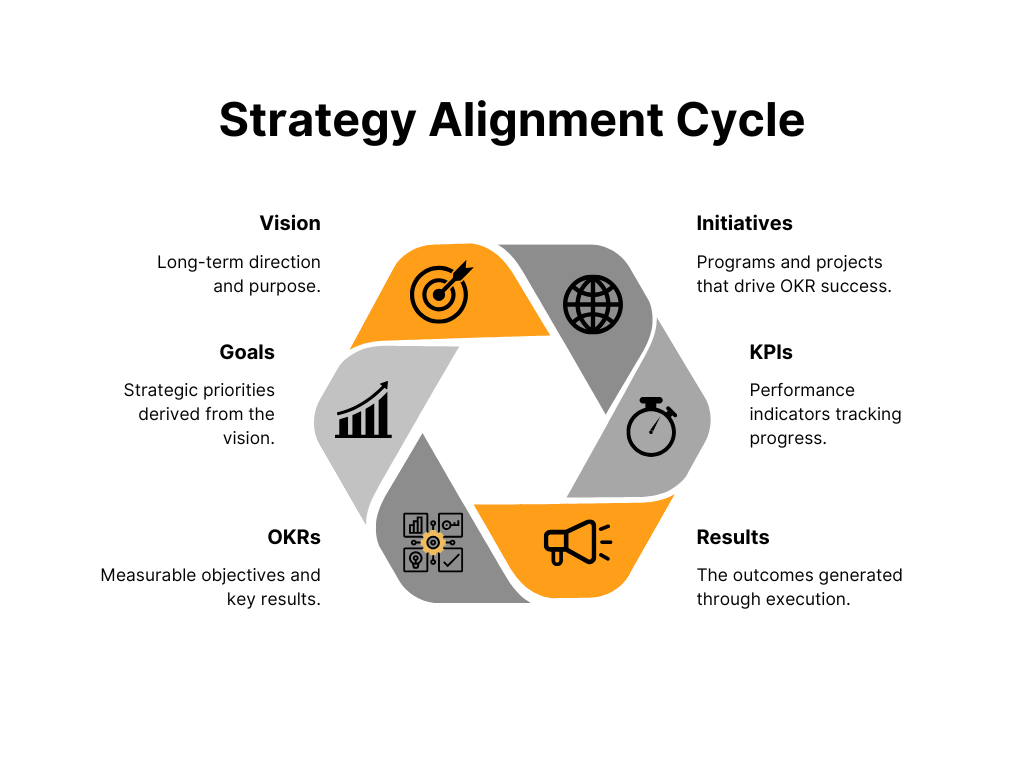
What “True Alignment” Looks Like in Practice
When strategy is genuinely aligned, each layer connects naturally:
-
Vision defines direction
-
Goals set measurable priorities
-
OKRs translate priorities into outcomes
-
Initiatives and work operationalize delivery
-
Dashboards and KPIs show real-time results
-
Risks surface blockers early
-
Reporting communicates progress clearly
When these parts live in one connected system, strategy stops being a document and becomes a living operating model.
Why OKR Alignment Matters More Than Ever
OKRs work best when they create clarity and focus across the organization. They help teams:
-
Prioritize what matters most
-
Align efforts across departments
-
Increase transparency
-
Track measurable outcomes
-
Connect strategy to execution
A unified platform makes that alignment easier because teams can see how outcomes connect to initiatives, owners, and progress—without manual rollups.
See How It Works: Watch the Demo Video
We created a short walkthrough that shows exactly how alignment improves when everything lives inside a unified strategy alignment execution platform.
FAQs
What is a strategy alignment execution platform?
It’s a system that connects vision, goals, OKRs, initiatives, and reporting so teams can execute from a shared source of truth.
How is this different from a project management tool?
Project tools track tasks. Alignment platforms connect tasks and initiatives to goals and outcomes—so you can measure whether execution is driving strategy.
When should we move on from spreadsheets?
When reporting becomes manual, visibility is delayed, or teams interpret priorities differently, it’s usually time to upgrade.
Learn more: What are OKRs?
Ready to Align Your Strategy With Execution?
If you’re ready to replace scattered spreadsheets and tools, explore how our strategy alignment execution platform helps you:
-
Features — Learn how unified strategy management works
-
Pricing — Choose the right plan
-
Request a Demo — See the platform in action
Bringing vision, goals, and execution into one system doesn’t just improve alignment—it accelerates outcomes.
