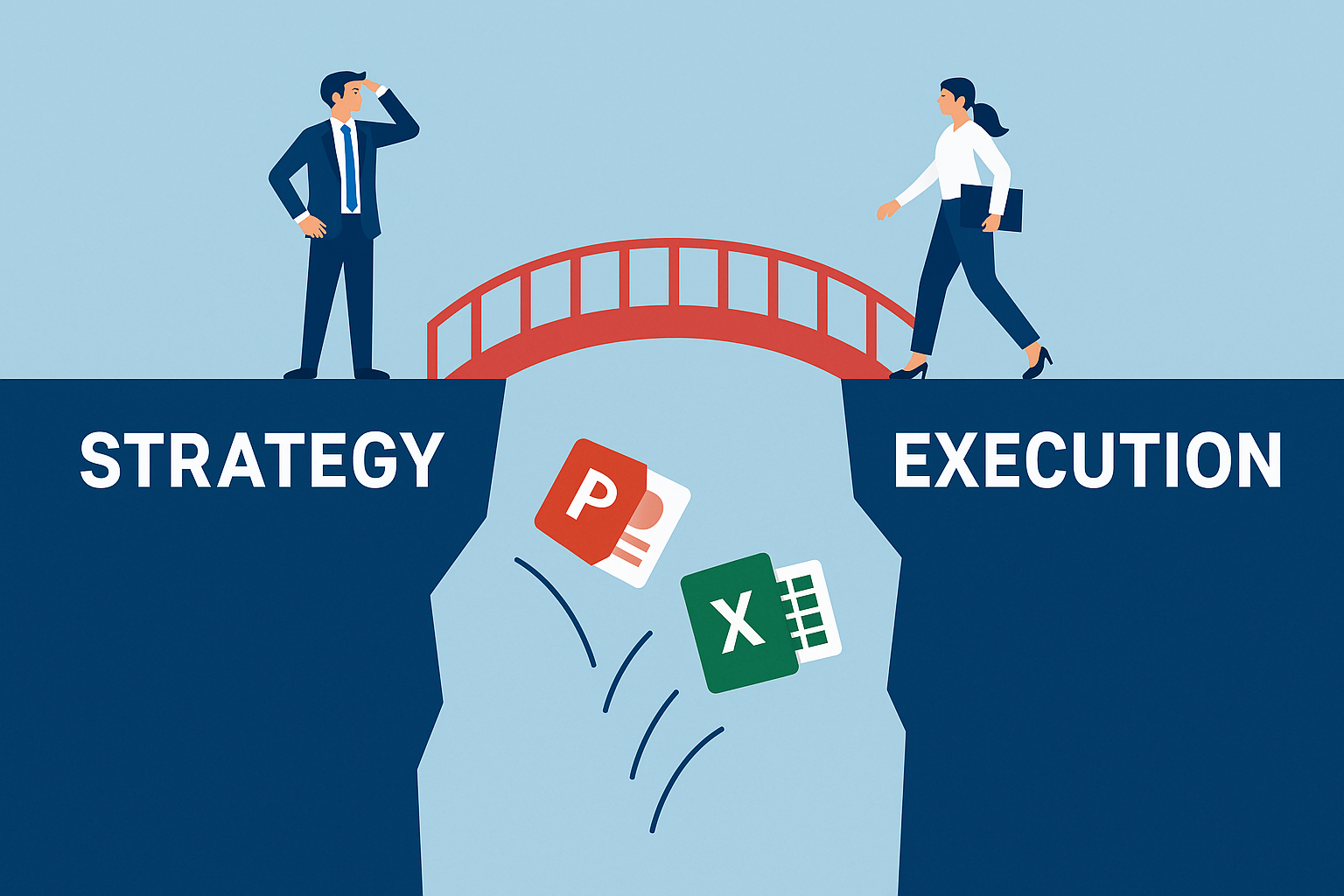
What’s the biggest roadblock to achieving business success today? Hint: It’s not a lack of strategy. It’s the gap between strategy creation and execution.
Far too often, organizations invest time and resources crafting the perfect business strategy, only to see it crumble during execution. Why? Traditional tools like PowerPoint, Excel, and BI dashboards simply can’t keep up with the dynamic nature of executing real-world business strategies. It’s time to rethink how we bridge this gap, and the solution lies in integrated strategy management software.
The Problem with Traditional Tools
1. Disconnected Frameworks
When your strategy lives in PowerPoint, your plans in Excel, and your data in a BI dashboard, your organization ends up operating in silos. These disconnected tools don’t offer a unified view of progress, making alignment across teams a near-impossible task.
2. Static, Not Dynamic
PowerPoint slides are static snapshots of intentions, not execution tools. Excel sheets can be clunky, error-prone, and difficult to scale. BI dashboards provide historical data but rarely offer actionable insights for the future. These tools keep businesses reactive, rather than proactive.
3. Overwhelming Complexity
Excel formulas, dashboards, and manual updates demand a level of effort that detracts from actual execution. Meanwhile, maintaining alignment requires constant manual communication, leading to inefficiencies and delays.
The result? Strategies stagnate, execution falters, and businesses find themselves spinning in circles, unable to turn plans into tangible results.
The Solution: One Unified System
To truly bridge the gap between strategy and execution, businesses need more than a collection of tools—they need one system that brings it all together. That’s where integrated strategy management solutions like Core-Strategy can transform the game.
Explore our Strategy Execution Platform to see how Core-Strategy aligns strategy and execution
Why Core-Strategy Changes Everything
Core-Strategy is more than just a software tool—it’s the connective force that seamlessly aligns your business strategy and execution. By addressing key operational challenges, it empowers organizations to transform strategic plans into measurable results with clarity, collaboration, and control.
1. Centralized Workflows for Complete Alignment
To begin with, Core-Strategy eliminates silos by consolidating everything in one unified platform. From defining organizational missions and KPIs to assigning tasks and tracking progress, every element is connected. As a result, leaders gain full visibility, teams stay aligned, and communication flows effortlessly across departments.
2. Dynamic, Real-Time Updates for Smarter Decisions
Furthermore, Core-Strategy transforms static plans into dynamic execution frameworks using built-in models like OKRs, Balanced Scorecards, and KPIs. Because updates and insights are available in real time, teams can quickly adapt, refine strategies, and make data-driven decisions that keep projects moving forward efficiently.
3. Simplicity and Accessibility Without the Complexity
In addition, Core-Strategy’s intuitive design and interactive tools make strategic planning simple, engaging, and effective. No longer do teams need to juggle complicated Excel sheets or outdated PowerPoint slides. Instead, the platform provides visual dashboards and streamlined workflows that help your organization move forward with focus, precision, and confidence.
Real-World Results
Companies using Core-Strategy have reported higher alignment across teams, faster decision-making, and better goal achievement. For example, a mid-sized technology firm using Core-Strategy reduced project delays by 30% because their teams were no longer dependent on disparate tools.
Another organization saw its employee engagement scores rise significantly because leaders and employees finally felt aligned on shared goals and responsibilities.
Addressing Industry Challenges
The need for strategy-execution alignment isn’t limited to one industry. Across sectors, the challenges are consistent:
- Manufacturing struggles to streamline supply chain processes while adapting to shifting demands.
- Technology firms face challenges maintaining alignment during periods of rapid innovation.
- Retail businesses need tools that clearly align team efforts with fast-changing consumer trends.
Core-Strategy addresses these challenges head-on by delivering industry-specific models and customizable features that match the unique needs of any enterprise.
Learn how our AI Plan Assistant helps organizations connect real-time data with strategic performance goals.
Why Your Business Can’t Afford to Wait
Failing to close the strategy-execution gap doesn’t just slow progress. It puts your competitive advantage at risk. Businesses that can repeatedly turn strategy into action will outpace those stuck in the cycle of misalignment and inertia.
Your competitors are already exploring innovative solutions. The longer you rely on outdated tools, the greater the gap becomes between potentially growing and falling behind.
Get Started with Core-Strategy Today
Core-Strategy was built with one goal in mind: to eliminate the barriers to execution so businesses like yours can thrive.
If you’re done wrestling with disconnected tools and ready to see your strategies, come to life, it’s time to experience the difference Core-Strategy can make.
Learn how Core-Strategy can transform your business. Click here to schedule your demo today.
Read more about Strategic Portfolio Management and how it drives agile execution across teams.